
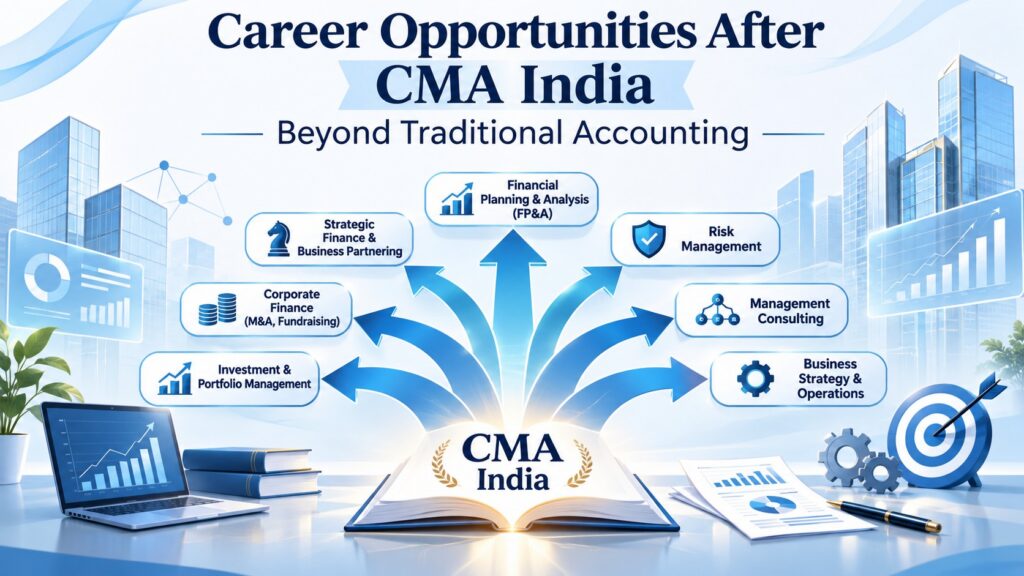
Career Opportunities After CMA India Beyond Traditional Accounting
When people think about a career in accounting, they often imagine maintaining financial records, preparing balance sheets and calculating taxes. However, the field of finance offers much more than these responsibilities. Businesses today need professionals who can manage costs, analyse financial performance, improve operational efficiency and support important business decisions.
This is where the Cost and Management Accountant (CMA) qualification can be useful. Offered by the Institute of Cost Accountants of India (ICMAI), CMA India provides knowledge of cost accounting, financial management, taxation, auditing and business strategy. Let’s explore some career opportunities CMA professionals can consider beyond conventional accounting roles.
Why CMA India Offers More Than Accounting Careers
The CMA curriculum covers several areas that are important for running a business. Students learn how organisations manage expenses, prepare budgets, evaluate financial performance and use resources effectively.
These skills are useful across different departments, not just accounting teams. For example, a manufacturing company may need a CMA professional to analyse production costs, while a consulting firm may require someone who can review business processes and recommend improvements.
The qualification also develops analytical and problem-solving skills. This allows professionals to explore roles where financial knowledge is used to support wider business objectives.
Career Opportunities After CMA India
Here are some career paths that CMA professionals can explore beyond traditional accounting positions.
1. Financial Planning and Analysis (FP&A)
Financial Planning and Analysis is an important function in many large organisations. FP&A professionals help businesses prepare budgets, forecast future financial performance and understand differences between expected and actual results.
CMA professionals can apply their knowledge of budgeting, financial management and performance analysis in these roles. Their responsibilities may include:
- Preparing financial forecasts and budgets.
- Analysing revenue, expenses and business performance.
- Identifying financial trends and possible cost issues.
- Supporting management decisions through financial reports.
2. Business and Management Consulting
Consulting is another career option for CMA professionals who enjoy solving business problems. Consultants work with organisations to understand operational challenges, improve processes and make better use of resources.
A CMA’s understanding of cost management and financial performance can be useful when advising businesses on improving efficiency. Professionals can explore opportunities with consulting firms or work in internal business advisory teams, depending on their experience and skills.
3. Risk Management
Every organisation faces financial and operational risks. These may include unexpected expenses, cash flow problems, changes in market conditions or weaknesses in internal processes.
Risk management professionals help businesses identify these issues and develop ways to manage them. CMA professionals can use their understanding of financial systems, internal controls and business operations in areas such as:
- Financial risk assessment.
- Internal control reviews.
- Operational risk management.
- Compliance monitoring.
- Business process evaluation.
4. Corporate Finance and Strategic Management
Corporate finance involves managing an organisation’s financial resources and supporting decisions related to investments, funding and business growth.
CMA professionals can build careers in this area by working on financial analysis, capital budgeting, investment evaluation and financial planning. As they gain experience, they may also become involved in strategic discussions about business expansion, resource allocation and profitability.
5. Supply Chain and Operations Management
Financial knowledge is also useful in managing supply chains and business operations. Companies need to understand procurement costs, inventory expenses, production efficiency and distribution costs.
CMA professionals can apply their costing and analytical skills to these responsibilities.
Some areas of work include:
- Analysing procurement and inventory costs.
- Reviewing production expenses.
- Monitoring operational budgets.
- Evaluating supplier costs.
- Identifying opportunities to improve efficiency.
6. Internal Auditing and Corporate Governance
Internal auditing is not limited to checking financial records. It also involves reviewing business processes, examining internal controls and identifying areas where an organisation may face risks.
CMA professionals can explore internal audit roles because their training includes cost management, auditing and financial control. They may work with companies to review operational procedures, assess financial controls and recommend improvements.
With relevant experience and additional expertise, professionals can move towards senior internal audit and governance-related positions.
7. Entrepreneurship and Independent Consulting
CMA India can also provide a foundation for individuals interested in starting their own professional practice or business.
The qualification develops knowledge of financial planning, cost control, taxation and business management. These skills can be useful when advising businesses or managing an organisation. CMA members may explore professional practice in areas permitted under the Cost Accountants Act and applicable regulations.
Industries That Hire CMA Professionals
CMA professionals are not restricted to accounting firms. Their skills are relevant across several industries where financial planning and cost management are important.
Some potential employment sectors include:
- Manufacturing
- Banking and Financial Services
- Information Technology
- Consulting
- Healthcare and Pharmaceuticals
- Infrastructure and Energy
Skills That Can Improve Career Opportunities After CMA
Completing the qualification is an important step, but professionals should continue developing skills that are relevant to modern workplaces.
Some useful areas to focus on include:
- Advanced Excel: For financial modelling, budgeting and data analysis.
- Power BI: For creating financial dashboards and understanding business performance.
- Communication: For explaining financial findings to managers and clients.
- Data analysis: For identifying trends and supporting business decisions.
- Problem-solving: For evaluating financial challenges and suggesting practical solutions.
- Technology awareness: For understanding accounting software and digital financial systems.
Conclusion
CMA India offers career opportunities that extend well beyond traditional accounting. From financial planning and consulting to risk management and corporate strategy, the qualification provides knowledge that can be applied across different business functions.
For students who enjoy working with numbers but also want to understand how businesses operate, it can be a valuable professional qualification. The key is to identify an area of interest, develop relevant technical skills and gain practical experience. With continuous learning and professional growth, CMA professionals can explore several career paths in India’s evolving finance industry.